Thrusterfinance reserved ThrusterYield claims for the configured manager
Thrusterfinance reserved the claim functions in its published ThrusterYield implementation for the configured manager. The caller had to match that stored address, while the manager supplied the payment recipient. Liquidity provision or THRUST ownership alone did not satisfy this authorization check. The implementation belonged to the thruster-cfmm-0.3 package for Blast and handled USDB, WETHB, and gas claims. Thruster later announced a wind-down and tokenholder redemptions. The combined claim took separate requested token amounts, and the gas-only method offered a minimum-rate branch. Neither function implemented the tokenholder redemption process announced during the wind-down.
Key takeaway: Changing the stored manager changed claim authority, while the recipient remained an argument that the authorized caller selected.
Manager Authorization and Recipient Selection
The
onlyManager
modifier allowed a function call only when
msg.sender
matched the address stored as
manager
.
A mismatch triggered
FORBIDDEN
before the function body ran. That modifier protected
claimYieldAll
,
claimGas
, and
setManager
, without testing token balances or ownership of liquidity-pool positions.
The authorized caller supplied the recipient separately, so the address that received the assets did not have to hold the manager role. Naming an address as recipient conferred no permission to submit later claims.
Claimable Yield and Blast Configuration
The constructor configured the USDB and WETHB token instances for claimable yield and enabled claimable gas through Blast. That configuration concerned yield and gas attributable to the contract instance, without creating an automatic per-wallet distribution through these functions. The identifiers
USDB
and
WETHB
referred to token contracts, with separate claim amount arguments. Liquidity-pool trading fees and historical points campaigns involved different mechanisms from these yield and gas calls.
Separate Token Amounts in the Combined Claim
claimYieldAll
accepted one recipient and separate requested amounts for WETHB and USDB; its name did not remove those amount arguments. The implementation passed the requested amounts unchanged to WETHB's
claim
method first, followed by USDB's corresponding method. The final external call used
claimMaxGas
for the yield contract's own address and the same recipient.
Successful execution reached the
ClaimYieldAll
event, which contained the recipient,
amountWETH
,
amountUSDB
, and
amountGas
. Each amount variable took its value from an external call's return, without a separate balance-difference calculation. Input arguments specified requested token amounts; the event fields reported what the external claim calls returned.
Both token claim calls remained in
claimYieldAll
even when an amount argument was zero; the wrapper contained no zero-amount skip branch. The token contract's behavior determined whether that external call accepted a zero request. The wrapper did not catch external call failures, so a revert rolled back the combined claim, including earlier token transfers, and prevented its final event. The token and gas calls formed one function execution, with
ClaimYieldAll
emitted only after every external call returned.
The event recorded returned claim amounts without capturing the recipient's complete wallet balance.
Gas Claims Followed the Threshold Argument
claimGas
handled a gas-only claim with a recipient and the
_minClaimRateBips
argument. That argument selected the Blast gas method, with both branches retaining the manager check and forwarding the supplied recipient.
The Gas-Only Branches
A Zero Threshold
A zero
_minClaimRateBips
value selected
claimMaxGas
, using
address(this)
to identify the contract whose gas was being claimed. Blast's published v1.0.0 implementation used this path for gas eligible at the maximum claim rate. It reverted if no gas qualified. The zero argument did not fix a payout amount.
A Nonzero Threshold
A nonzero
_minClaimRateBips
value selected
claimGasAtMinClaimRate
.
The wrapper forwarded that threshold with the contract address and recipient to the underlying Blast method. Blast's published v1.0.0 implementation interpreted that rate in basis points as the payout share of gas-fee accrual. It rejected thresholds above its configured ceiling and reverted when it calculated no eligible gas to claim. The outer wrapper contained no waiting-period calculation or fixed payout amount.
The Combined Method's Fixed Gas Path
claimYieldAll
always invoked
claimMaxGas
after its token claims. Its arguments contained no minimum-rate field; the threshold-selecting gas branch belonged to
claimGas
in this implementation.
The
ClaimGas
event recorded the recipient and the amount returned by the selected Blast call. The function returned that amount to its caller as well, keeping the gas-only output separate from the combined method's token fields.
Manager Reassignment Across Contract States
setManager
let the existing manager replace the stored manager address. After a reassignment, a former manager address had no continuing claim permission when it differed from the stored value.
The constructor took
_manager
explicitly and assigned that value, so deployment alone conferred no separate permission through the modifier. The initial assignment and any later
setManager
call affected the same stored field. Permission for one instance therefore depended on that instance's manager state.
A Gas-Only Claim Under the Same Manager Check
For a manager seeking gas alone,
claimGas
avoided the token-call dependencies that
claimYieldAll
retained. The chosen instance still had to recognize the caller as manager before the gas call could proceed.
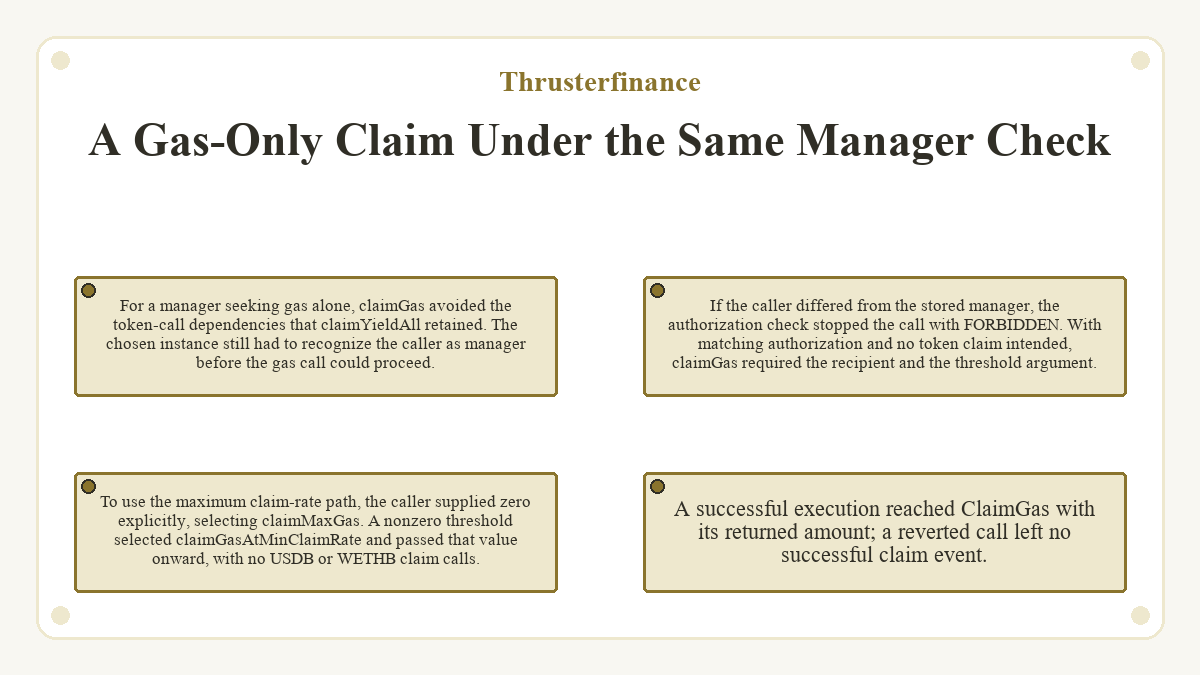
-
If the caller differed from the stored manager, the authorization check stopped the call with
FORBIDDEN. -
With matching authorization and no token claim intended,
claimGasrequired the recipient and the threshold argument. -
To use the maximum claim-rate path, the caller supplied zero explicitly, selecting
claimMaxGas. -
A nonzero threshold selected
claimGasAtMinClaimRateand passed that value onward, with no USDB or WETHB claim calls. -
A successful execution reached
ClaimGaswith its returned amount; a reverted call left no successful claim event.
The Boundary With Tokenholder Redemption
Thruster's wind-down announcement concerned tokenholder redemptions. This yield implementation contained no THRUST redemption calculation, eligibility rule, or deadline. Its manager guard also contained no test of a holder's THRUST balance. Manager authorization therefore did not establish eligibility for a separate redemption. A THRUST redemption could not be established by a yield-claim event such as
ClaimYieldAll
.
Thrusterfinance FAQs
Could a Contract Address Hold the Manager Role?
The manager field accepted an address without restricting it to a personal wallet. Its guard compared msg.sender with that value. If a contract held the role, ownership of that contract did not give its owner's wallet direct claim permission. A call from the configured contract had a different sender from a direct wallet call.
Did Either Manager Assignment Reject the Zero Address?
Neither manager assignment included an explicit nonzero-address check. The constructor accepted _manager, and the protected setManager function assigned its argument directly. The onlyManager modifier then used the stored value for later authorization. Setting the manager to zero would block both claim methods and further manager reassignment through this implementation.
Was the Manager Value Readable Without Claim Permission?
The public manager declaration exposed a read getter without the onlyManager restriction. Reading that value did not grant authority to change it or initiate a claim. The restricted methods separately checked the caller against the stored address.
How Did ThrusterYield Handle Token Decimal Conversion?
ThrusterYield passed requested token amounts to the token claim methods without a decimal-conversion calculation. Its amount arguments and returned amount variables used uint256. The wrapper applied no rescaling, so each argument had to use the units that the corresponding token claim method expected.
Which Event Field Supported Filtering Claims by Recipient?
The recipient address was indexed in both ClaimGas and ClaimYieldAll, allowing log queries to filter on that address. Their amount fields were not indexed. Recipient filtering identified the address recorded by a claim event; it did not grant that address manager permissions.
Did setManager Emit a Dedicated manager-change Event?
The published setManager function assigned the new address without emitting a dedicated manager-change event. ClaimGas and ClaimYieldAll concerned claim activity and did not record manager reassignment. The public manager getter exposed the stored value, while a list of claim events alone did not provide a manager-change history.